Enhancing Soil Stability with Bi-Modulus Columns: The Innovative Combination of CMC and Stone Columns
Bi-modulus columns is a ground improvement technique that reinforces the soil by a combination of CMC and stone columns.

Bi-Modulus Column, a combination of two techniques
The bi-modulus column technique, developed in the early 2000s, consists in topping Controlled Modulus Columns with a compacted granular material. In 2009, Menard drew up a specification and had it approved by independent technical third party. To date, Menard has successfully carried out numerous projects using the method.
Implementation
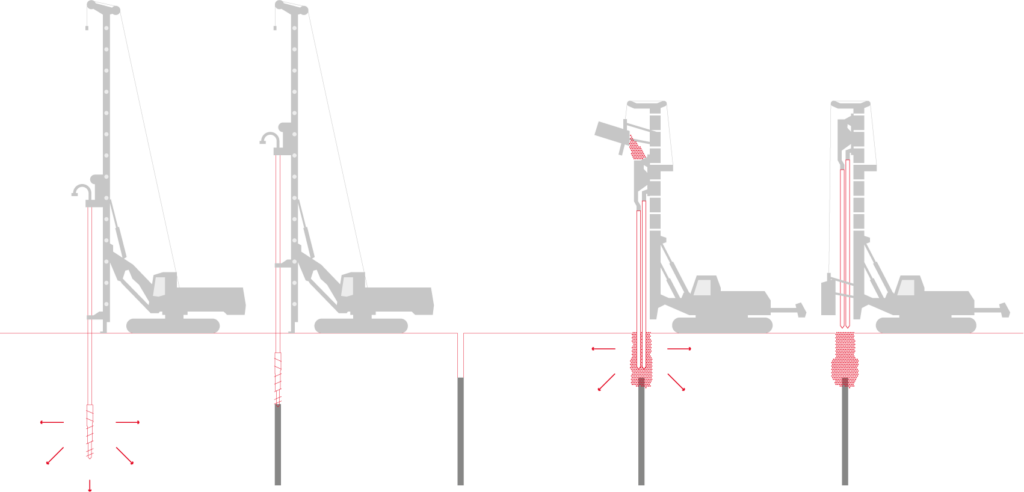
Controlled Modulus Columns are first installed with concrete stopping at least 1 meter above the bi-modulus interface level in order to ensure continuity. Following an initial curing period, there is a window of several hours during which the granular top is installed. It is formed by a stone column interpenetrated into the Controlled Modulus Columns head with a height of at least 50 cm over the top of the Controlled Modulus Columns.
Applications
Bi-modulus columns are particularly effective in cases of deep cut-off, to avoid unwanted moments in slabs on backfill or in a seismic zone. All these elements have generated exponential growth in the use of the technique since it was developed.



Contact us today to ensure the safe and reliable operation of your industrial plant and equipment. Our foundation solutions are tailored to your unique needs and soil conditions, providing cost-effective and durable results.
Bi-Modulus Columns FAQs
Two main types of tests – loading and stripping – are carried out during the project to ensure, through visual inspection, the quality and quantity of the interface.